
The Voice of Dentists for 60 Years

Constitution of the Association professionnelle des chirurgiens dentistes du Québec (Gazette officielle du Québec, June 18, 1966), born of a clear desire to represent and defend the interests of dentists. It will adopt the name Association des chirurgiens dentistes du Québec (ACDQ) in 1970. Like other professional associations, the ACDQ also benefits from the RAND formula, ensuring the funding essential to support services to its members and its ability to fully represent the needs of dentists.
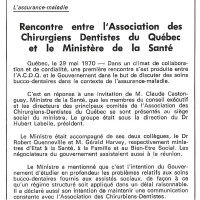
Quebec’s health insurance plan comes into effect under the Robert Bourassa government. In 1974, after many representations by the ACDQ, the government set up the first public dental plan for children aged 0 to 8.

The ACDQ publishes its first Fee Guide and Description of Dental Treatment. This milestone would become the first in a series of essential tools for dentists in Quebec, developed according to a rigorous methodology by a committee of dentists and other experts to accurately reflect the real operating costs of dental clinics. Over the years, and to this day, the ACDQ has lobbied insurers to recognize the value of dentists’ fees and expertise.

The ACDQ conducts its first negotiations within the framework of the Quebec Health Insurance Plan (RAMQ).
That same year, the creation of a dental hygiene program in six CEGEPs raised concerns about respecting dentists’ areas of expertise, which the ACDQ has defended.

The ACDQ founds Sogedent Assurances, its first subsidiary, to offer dentists, their families and dental students a range of insurance products and advisory services tailored to their professional reality. The insurance offer was expanded in 1985 with the repatriation of all Quebec dentists’ insurance portfolios held by the Canadian Dental Association (CDA).

The ACDQ becomes a shareholder in Financière des professionnels (known as Fonds médico-dentaire), developing investment and wealth management expertise, with assets under management growing from $10 million in 1981 to $8 billion in 2026. Today, this ACDQ partner is known as fdp Private Wealth Management.
Creation of the Société de services dentaires (SSD), an ACDQ subsidiary tasked with implementing a new program allowing insurers to pay covered amounts directly to dentists.

Implementation of Dentaide by the SSD, a service facilitating the management of fees claimed to participating insurers, which is in line with the Association’s desire to preserve the therapeutic freedom and professional independence of dentists in the face of pressures linked, in particular, to the delegation of payments and attempts by insurers to exert influence. In the 1990s and 2000s, the ACDQ opposed a number of initiatives aimed at creating networks of negotiated-fee dentists (PPOs), notably by groups such as police and student associations.

The ACDQ establishes a legal department to advise dentists on legal issues.

The ACDQ implements the first professional development course (PDC) in collaboration with dental societies, contributing to the ongoing development of dentists’ skills.

Dr. Micheline Blain becomes the association’s first female president, marking an important milestone in its history. Recognized for her commitment, leadership and deep sense of community, she died in office in 2001. That same year, the ACDQ created the Micheline-Blain Award, presented to a student from each of the dental faculties, in recognition of commitment, community spirit, and ability to represent peers.
Establishment of the Réseau ACDQ, a standardized protocol of norms and procedures that defines the terms and conditions for the electronic transmission of patient claims to participating insurance companies.

The ACDQ defends the right of dentists to incorporate in order to benefit from tax advantages.
In response to the threat posed by the emergence of a dental insurance claims processing solution backed by American interests, the ACDQ and Dentaide quickly mobilize to protect the gains achieved over the previous 20 years. The stakes are significant: preserving direct payment to dentists, preventing the imposition of claims transmission fees, and safeguarding dentists’ professional autonomy. An action plan is implemented, and discussions are held with several insurers to ensure Dentaide’s survival and long-term future.

Faced with the instability and sudden disappearance of several dental software providers, the ACDQ partnered with CTRL (designer of management software for the dental sector since 1992) and became the owner of the source code for the Progident dental management software. As the market stabilized in 2021, the ACDQ withdrew from this sector to refocus its activities on its primary mission.

Creation of the Net+ACDQ network, which enables claims to be routed securely while countering interference from insurers. A new solution, ACDQ Express, will be launched later, in 2022.
The ACDQ is opposed to the Bernier report, which, among other things, proposed a review of scopes of practice and reserved acts for all oral health professions. The ACDQ closely monitored this issue and intervened on several occasions, notably by submitting a brief and participating in parliamentary committee hearings in 2019 on Bill 29, An Act to amend the Professional Code and other provisions in the oral health and the applied sciences sectors, in order to defend dentists’ scope of practice.

ACDQ Board resolution on stopping payment delegation in order to preserve dentists’ autonomy and not be subject to constraints imposed by insurance companies.
The ACDQ announces support for the Auberges du cœur organization to provide free care to young people who find refuge in the 28 Auberges du cœur across Quebec.

The ACDQ sets up its financial incentive program to encourage students to do an internship in regions severely affected by labour shortages. The clinics welcome their first trainees in the summer of 2017.
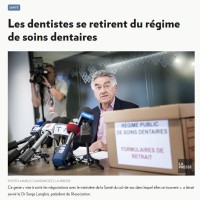
Faced with the impasse in the 2015-2023 framework agreement negotiations with the Quebec government, the ACDQ mobilizes its members. Over 2,000 dentists have filed nonparticipation forms to the RAMQ. That same day, the government imposes a ministerial ruling for a period of two years, suspending dentists’ right to become non-participants. The event illustrates the recurring battles waged by the ACDQ to have dental clinic operating costs recognized.
Launch of a general management training program for dental clinics, developed in partnership with HEC Montréal, an initiative that marks a first in Quebec’s healthcare sector. A second program focused on human resources management will be added to the offering in 2024.

The ACDQ launches the GREEN Program, developed in collaboration with RECYC-QUÉBEC, to help dental clinics adopt environmentally responsible practices. In 2024, the program wins the Project Vert ICI+ award at the Envirolys Gala.
The ACDQ participates in the Conseil interprofessionnel du Québec (CIQ) consultation about the investigative process by professional orders’ offices of trustees. The recommendations in its brief go on to be included in the CIQ’s report.

In response to the COVID-19 pandemic, the ACDQ implements a crisis unit, intensifies its public interventions and government representations, and sets up a daily communication channel to support its members during the clinic closures, which lasted nearly 3 months. The profession also mobilizes to contribute to public health efforts (vaccination, monitoring of asepsis protocols, etc.).

Joint efforts by the ACDQ and the Ordre des hygiénistes dentaires du Québec led, in a context marked by a labour shortage, to the return of the accelerated dental hygiene program at the cégep de Saint-Hyacinthe for foreign-trained dentists.
That same year, the ACDQ launches a human resources consulting service, in collaboration with Altifica, to help clinics manage their staff.

The ACDQ team organizes the first edition of Mordant, a unifying event created exclusively for dentists. It also launches an employer branding campaign to support recruitment and promote the profession.
The ACDQ restructures by closing its SSD subsidiary, which has been in business for over 40 years. It adds new expertise to its permanent staff and enhances its service offering to members.
When the federal government announces a public dental care plan, which will go on to become the Canadian Dental Care Plan (CDCP), the ACDQ redoubles its efforts to ensure the plan’s implementation respects dentists’ conditions of practice, especially their professional autonomy and their freedom to set their own rates.
The ACDQ deploys a series of measures to accompany clinics through the important reform of the Act respecting the protection of personal information in the private sector (Bill 25) as well as the adoption of the Act respecting health and social services information (Bill 5). It repeats its efforts in 2026 in response to major changes in occupational health and safety legislation.
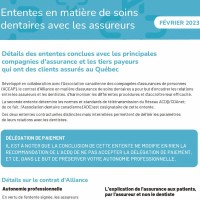
Developed in collaboration with the Canadian Life and Health Insurance Association (CLHIA), the ACDQ Alliance and Network contract is signed by all insurers with a significant customer base in Quebec. In particular, it aims to provide a framework for relations between dentists and insurers, while protecting dentists’ professional autonomy, harmonizing procedures and improving efficiency. Nearly 40 insurers and third-party payers sign these agreements.
The ACDQ joins the Sowingo purchasing platform, offering clinics simplified access to supplies and equipment at advantageous prices. This initiative is also designed to support the independence from big corporations for dentists who wish to do so.
The ACDQ launches danslesdents.ca as the core of a vast information campaign aimed at raising awareness of careers in the dental field among school guidance counsellors and high school students.
As part of the work surrounding Bill 67, An Act to amend the Professional Code for the modernization of the professional system and to broaden certain professional practices in the field of health and social services, the ACDQ joins the Table de concertation des associations de professionnel.les (TaCAP), a group of associations representing over 20,000 professionals. The aim of the initiative is to bring a concerted voice to the government to ensure that the work of trustees is properly supervised, and to prevent any potential abuses. The ACDQ is one of three associations to take part in the parliamentary commission studying Bill 67.

When the CDCP is expanded to people aged 18 to 65 in 2025, the ACDQ steps up its interventions with the government, namely to improve the clarity of communications and alleviate red tape for dental clinic teams. The ACDQ also reiterates that this program is financial assistance, not an entirely free service. Efforts that remain ongoing to this day.

The ACDQ’s subsidiary, Sogedent Assurances, merges with Sogemec Assurances to enhance insurance services for members. Following the merger, the ACDQ also becomes a shareholder in Sogemec.
The ACDQ celebrates its 60th anniversary. Since 1966, it has been committed to dentists by listening to them, bringing them together, and amplifying their voices. It pays close attention to their visions and rises with them through meaningful actions.
Today, as always, it is the voice of dentists.